A monoscopic 360° image shows the same picture to both eyes, so it has no depth of its own and reads as far away, like a sky. A stereoscopic 360° image stores a separate picture for each eye, offset slightly, and your brain turns the difference into depth. Stereo can be striking in filmed video, but its depth breaks when you tilt your head, fades out when you look straight up or down, and never changes as you move. For still worlds in interactive VR, a mono 360° world for everything distant, with real 3D geometry for everything near, gives better depth with fewer problems.
What mono 360° is
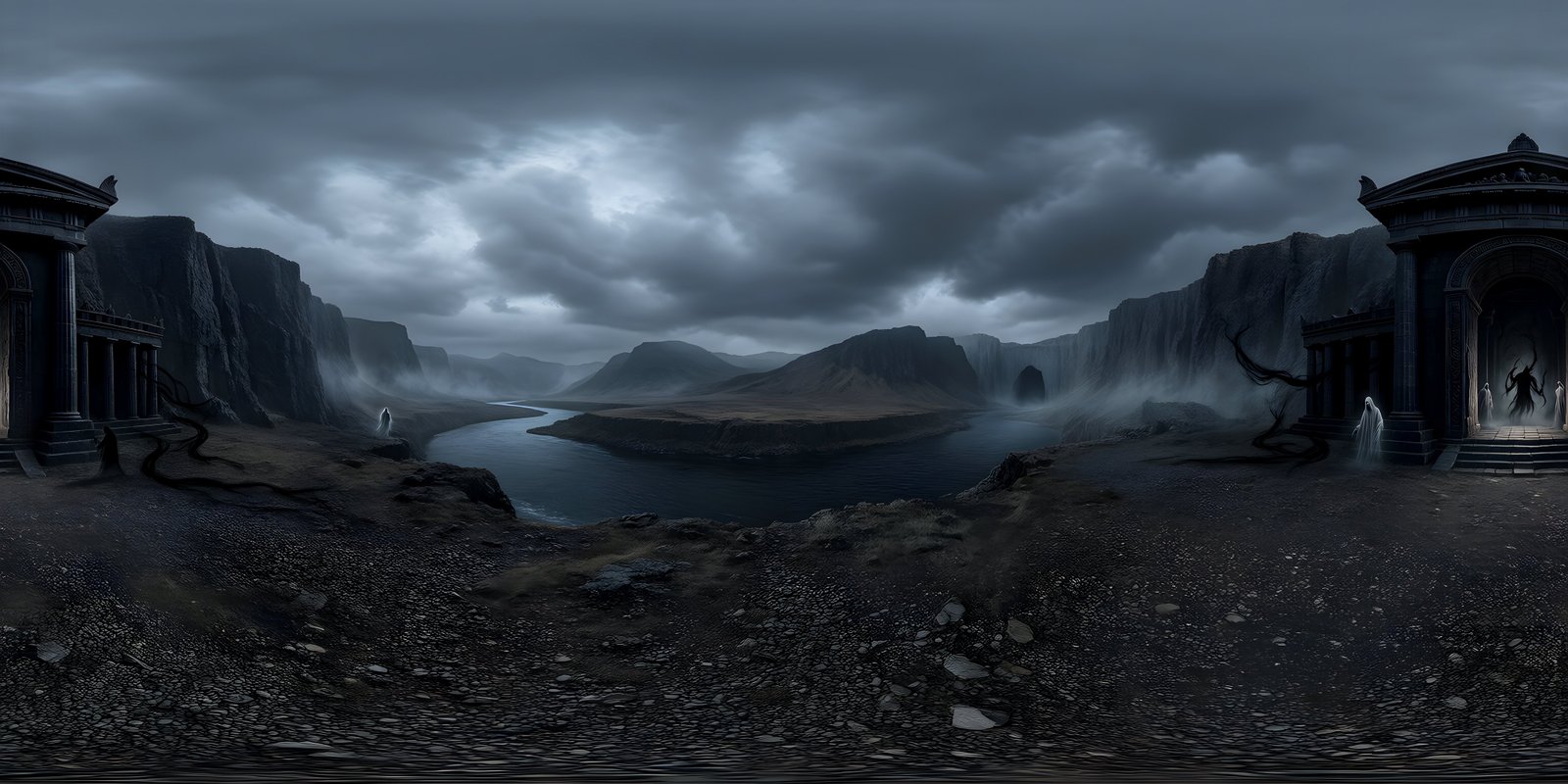
A mono 360° image is a single equirectangular image, the kind almost every 360° camera, viewer and skybox uses. In a headset, both eyes are shown exactly the same thing. With no difference between the eyes, your brain has no stereo cue for distance, and treats everything in the image as very far away.
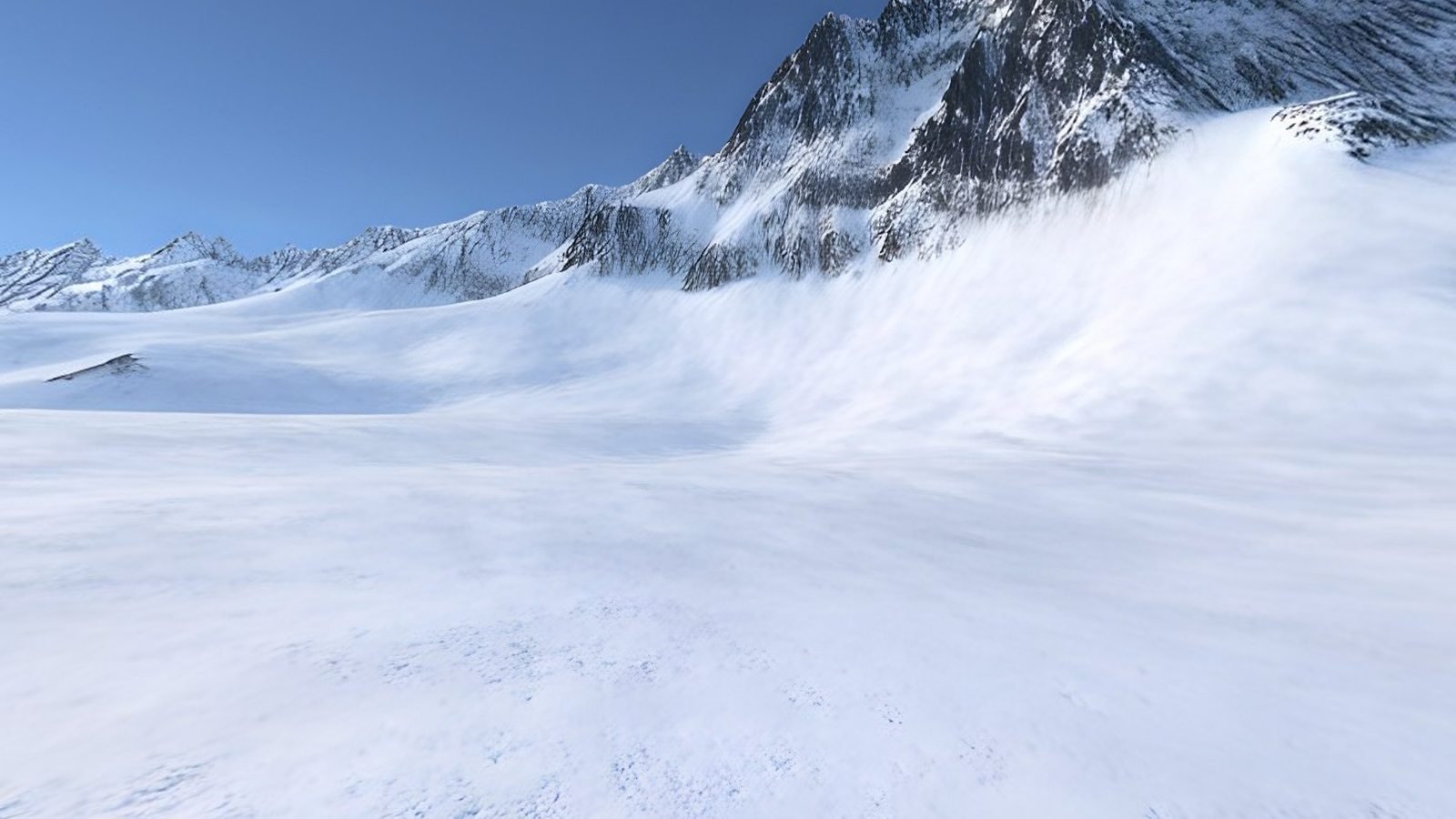
That is less of a limitation than it sounds. The difference between what your two eyes see shrinks rapidly with distance, so for mountains, skylines, clouds and anything else well beyond arm’s reach, mono is very close to what you would perceive anyway. Where mono falls short is up close: a table or a wall drawn into a mono image, right beside the viewer, looks like a painting of a table rather than a table, and its size becomes hard to judge. Without depth to go on, people read scale from familiar objects instead, which is why a mono world with a clear sense of scale, a door, a bench or a tree at a sensible size, feels more solid than one without.
What stereo 360° is, and how it creates depth
Your eyes are about six centimetres apart, so each sees the world from a slightly different position. Near objects shift more between the two views than distant ones, and your brain reads that shift, called disparity, as depth. Stereo 360° imitates it by storing two complete 360° images, one captured or rendered from the left eye’s position and one from the right, usually stacked one above the other in a single file. Each eye gets a full 2:1 image, so the file is square: an 8K stereo image is 8192 × 8192.
The clever part is that the offset has to work in every direction you might face. Stereo 360° images are built so that, whichever way you turn, the two images are offset sideways from each other, the way your eyes would be. Seated, facing the horizon and turning your head from side to side, the effect can be convincing, which is why stereo is popular for filmed 360° video.
Where stereo breaks
The offset is baked into the images, and it only suits one head position: upright, eyes level, at the centre. Real people do not stay there.
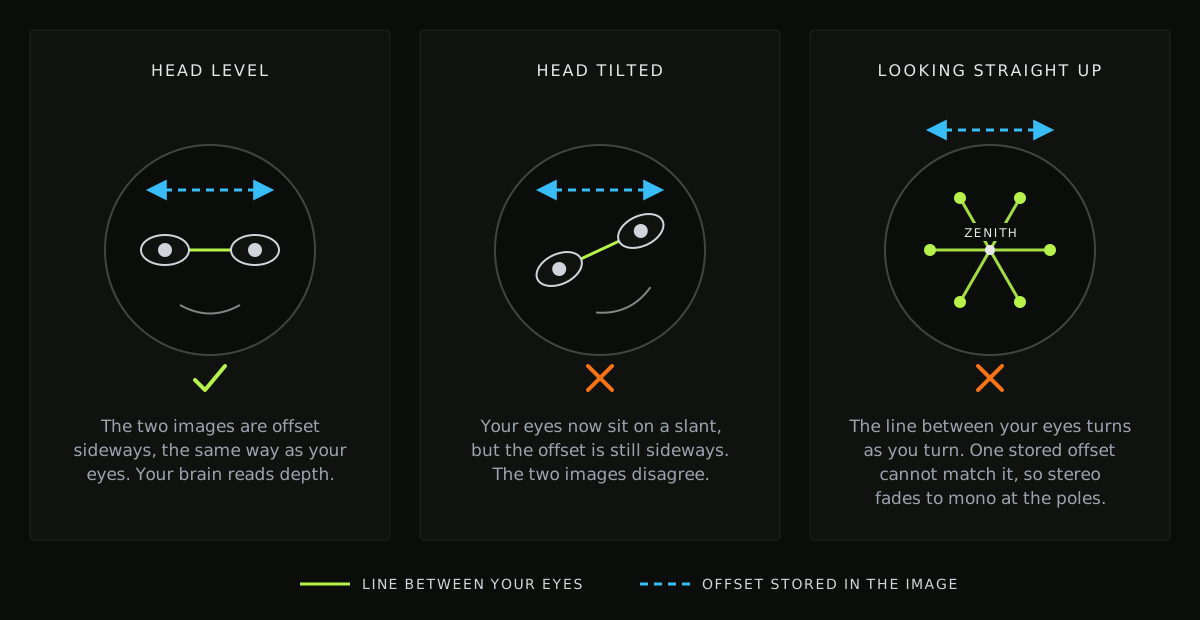
- Tilting the head. Lean your head towards one shoulder and your eyes sit on a slant, but the offset in the images is still horizontal. Now the two images disagree in a way real eyes never see, partly up and down as well as sideways. The brain struggles to fuse them, and the result ranges from a loss of depth to double vision and eye strain.
- Looking up or down. Straight overhead, the direction “sideways” depends on which way you are facing, and one image cannot hold an offset that suits every direction. Stereo images therefore blend to mono towards the poles, so the depth fades exactly where people look up at a ceiling or down at the floor.
- Moving. Stereo adds depth, not parallax. Lean or step sideways and nothing in the image shifts, just as with mono. In a headset that tracks your position, the mismatch between moving and the world staying put is easy to notice.
- Errors in the pair. Any difference between the two images other than the intended offset, such as a stitching error, a reflection or a detail present in one eye only, is felt as discomfort rather than seen as a flaw. VR comfort covers the other common causes. It also costs twice the pixels of mono for the same sharpness.
Why a mono world with 3D geometry works best
Most comparisons of mono and stereo are written about filmed video, where the choice is between two ways of recording a real scene. Interactive VR with still worlds has a better option than either: split the scene by distance.
- Everything distant comes from a mono 360° world: the sky, the horizon, far buildings and landscape. At those distances, stereo would add almost nothing anyway.
- Everything near is real 3D geometry: the floor, furniture, rocks, railings, anything the player can walk up to or reach for. Geometry is rendered separately for each eye from the eye’s true position, so it has correct depth from any head angle and correct parallax as the player moves.
The combination does what neither kind of 360° image can. Depth survives a tilted head and a look at the floor, because the near objects are real. The world gives the scene its sense of place at half the pixel cost of stereo. And there is no pair of images to keep in perfect agreement. A floor or platform under the player’s feet, at the right height, does the most work for the least effort: it grounds people immediately.
This is also how film teams use generated worlds for previs and virtual scouting: the world as the backdrop, with proxy geometry in front of it wherever the camera or the viewer gets close. WorldGen360 Studio generates mono worlds for exactly this combination, and its Clear viewpoint setting keeps open space around the camera, with nothing large right in front, which leaves room for your own geometry.

WorldGen360 Studio
The distance, done
Generate the mono world for everything far away, with open space around the camera for the floor, the props and anything else you build in 3D.
- Clear viewpoint keeps space around the camera
- Ground-level or aerial viewpoint
- Up to 8192 × 4096
Which to choose
| Situation | Choose |
|---|---|
| Filmed 360° video with nearby subjects, viewer seated | Stereo can be worth it |
| A still world for an interactive VR app or game | Mono world, plus 3D geometry for anything near |
| Skies, landscapes and distant scenery | Mono: stereo adds almost nothing at distance |
| Web 360° viewers on phones and desktops | Mono: screens show one image anyway |
| Experiences where people look up, down or tilt their heads | Mono with geometry |
| Tight memory, such as standalone headsets | Mono: half the pixels for the same sharpness |
Whichever you choose, resolution matters more in a headset than anywhere else: see the best resolution for VR 360° images. The complete guide to VR environments covers design, comfort and delivery.
Frequently asked questions
What is the difference between mono and stereo 360°?
Mono 360° shows one image to both eyes, so it has no depth of its own. Stereo 360° shows each eye its own image, offset slightly, which creates depth while the head stays level and looks towards the horizon.
Is stereo 360° better for VR?
For filmed video with nearby subjects and a seated viewer, it can be. For interactive VR, usually not: its depth breaks when the head tilts or looks up or down, it gives no parallax, and it doubles the pixels. A mono world with real 3D geometry in front gives better depth.
Are AI-generated 360° worlds mono or stereo?
Generally mono. WorldGen360 Studio generates mono worlds, designed to surround a scene as the distant environment, with 3D geometry added for anything near the viewer.
Can you turn a mono 360° image into stereo?
It can be approximated, by estimating the depth of every pixel and synthesising a second view, but the depth is a guess, hidden areas have to be invented, and the result has the same limits as any stereo 360° image. For interactive VR, adding real geometry in front of the world is more reliable.